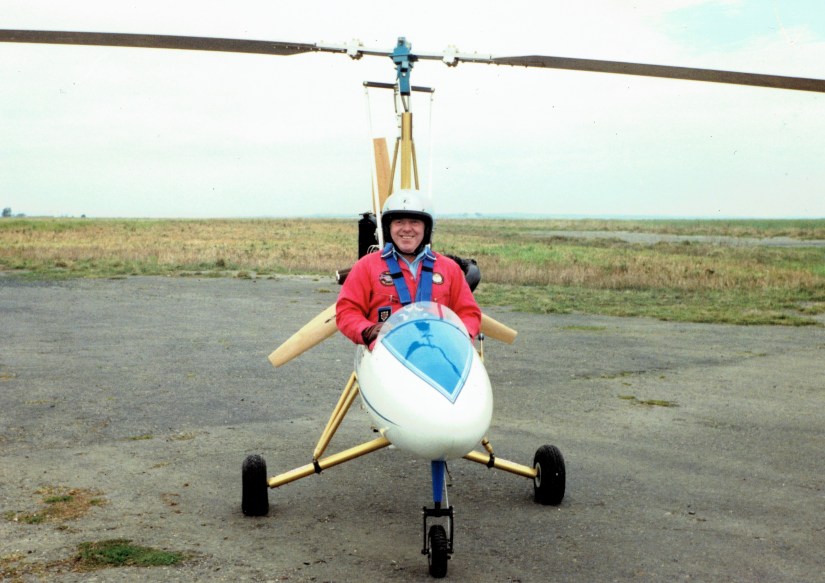
Chris Julian was killed on the morning of May 17th 1997.
Sunday the 18th of May 1997 was a beautiful day, bright and sunny with blue sky. As usual, I went outside and sat on the wall to look at the weather and the wonderful view of Cornwall stretching away into the distance, watching the windmills turning through the tears in my eyes. The familiar scene gave no clue to the tragic events of the previous day, the only difference was that Chris Julian didn’t come out to join me as he often did. We would watch his two dogs playing in the field, while waiting for our new friend Bob Bond to arrive on his motorbike from Exeter. After the obligatory cup of tea, we would all pile into Chris’s old car – me in the back buried under three lots of flight gear, tools and crash helmets – and hurtle off to St. Merryn laughing and joking all the way and often completely on the wrong side of the road. It was very quiet on Sunday the 18th of May.
Chris was a legend in the British gyroplane world. Many of us gyronauts survive because he taught us how to do so. It’s sad that so few remember him now, or even know who he was. I’ll add to this in time, but tomorrow is May 17th, a particularly poignant day to remember Chris Julian, and also Bob Bond who died beside him when the rotor assembly detached in flight.
Everyone knew Chris back then, or knew of him. Larger than life and always laughing, he was a proper character – and helluva gyroplane pilot. Partnered by Tony Philpotts in the tow car, Chris tutored many hundreds of student gyronauts in the art of autorotation, patiently hauling back and forth on the gyro-glider over and over again and loving every minute of it. Learn rotor handling first and everything else will fall into place. I wonder what he would make of it all now.
I was watching some of the self-styled ‘new generation’ in action recently: hammering the pre-rotator until the last moment, even though there was a cracking bit of wind right down the runway, then flogging the poor machine to climb out on the back of the power curve. What’s all that about? As for the chap with the navy blue Cavalon, turning the propeller while stood right inside the prop arc with his arms draped around the blades – that doesn’t bear thinking about. Chris would have put them all straight, in no uncertain terms.

The picture above means a lot to me, and Chris loved it too. We made a poster of it which he pinned to the wall in our hut at St. Merryn. By sad coincidence it turned out to be our last flight together. It was a beautiful Easter Monday, a quiet day at the gyro’s nest for once, just the pair of us out to play. We spent a leisurely couple of hours in the sunshine, cleaning and checking over our gyroplanes, happy just to be there doing what we loved. Later we flew across to Bodmin to enjoy an excellent lunch, sat outside the clubhouse chatting about everything and nothing and watching the flying on that lovely grass airfield. It was a lazy sort of day, the colours bold, green grass, blue sky, bright sun. Chris wanted to treat me to an ice cream but I was too full to manage any more, so he bumbled off to order one for himself. Returning to our table, he realised his head was sunburnt: I fished a duster from the pocket of my gyroplane and he fastened it around his head with the two miniature bungees that he used to attach his radio in flight, thus Lawrence of Bodmin was born. When his ‘bocker-nocker-lorry’ arrived (he couldn’t pronounce knickerbocker glory!), the image was complete. I had to get a photo, never dreaming how poignant it would become. As he drove us home later that evening, he looked across at me and said reflectively ‘You some dear little gyrocopter pilot really, Shirley.’ – and reached over to squeeze my hand – after wiping his nose in his palm!
So who was Chris Julian? Rosy of face and cheerful demeanour, his bald head framed by a shock of unruly white hair, this dumpy figure clad in open-necked shirt and corduroy trousers could easily be dismissed as a quintessential yokel – the country bumpkin persona thrice enhanced by his broad Cornish accent. But Chris was a virtuoso of the free-spinning rotor blade: there was nothing he couldn’t do within parameters and even a few things beyond. Back in the 1960s, he learned his skills from the first two gyroplane pilots in Cornwall, Charlie Force and David Bazeley, and for the next three decades he passed those skills on to people like me. The Wombat Gyrocopter was his pièce de résistance, and in the skies above St. Merryn he made her sing. Poetry in motion, they were a joy to watch – from a suitably sheltered vantage point where you couldn’t be dive-bombed! He was a terror for that, the old devil.
But when in instructor mode, student safety was paramount and his concern was absolutely genuine. He taught me everything about rotor handling, and our only instrument was a piece of string. It never lies: the batteries never fail, the readout never goes blank. Learn rotor handling first – proper manual hand-start rotor handling – and everything else will fall into place. 26 Years of flying with a bit of string and yet to ding a rotor blade, thanks to Chris Julian, faithfully assisted on the glider by Tony Philpotts.

Postscript. I also pay tribute here to Robin Morton, who sadly succumbed to illness earlier this year: a very clever man who had many an aviation string to his bow, including those of gyroplane inspector and enthusiast. At the 1997 PFA rally, stunned British gyronauts gathered from around the country still reeling in shock, two months after the double fatality at Kemble. We were all in denial. No one could believe it: not Chris – not in a gyro-glider. The latest issue of Rotor Gazette International had been dedicated to him, featuring my unpolished outpouring. I don’t remember much about that weekend, but I’ve never forgotten how an emotional Robin approached me that day and clasped both my hands in his. ‘You must write, my dear’ he implored, eyes bright with tears. Holding me close in mutual sorrow, he repeated softly ‘You must write.’
I did, Robin. Thanks to you. I did.
 Spinning on the Wind