Autorotational musings

Spinning without the wind

A final scribble culled from This Way Up. It’s getting there.

I dodged another bullet during this escapade from October 2021. We had just returned from a squadron fly out to nearby Sabonnères, visiting the resident model club who gave us an impressive demonstration of their not-so-miniature craft. It was a poignant trip as my last flight to Sabo was with Gègè in his ill-fated Air Copter. That big machine was so amazingly light on the controls (even lighter than Delta-J) that I could hardly feel the rotor. It was an enigma to me. This time I was in company with a reduced but no less enthusiastic crew of Eric, Pierre and Gèrard, who had generously offered to burden themselves with my presence.

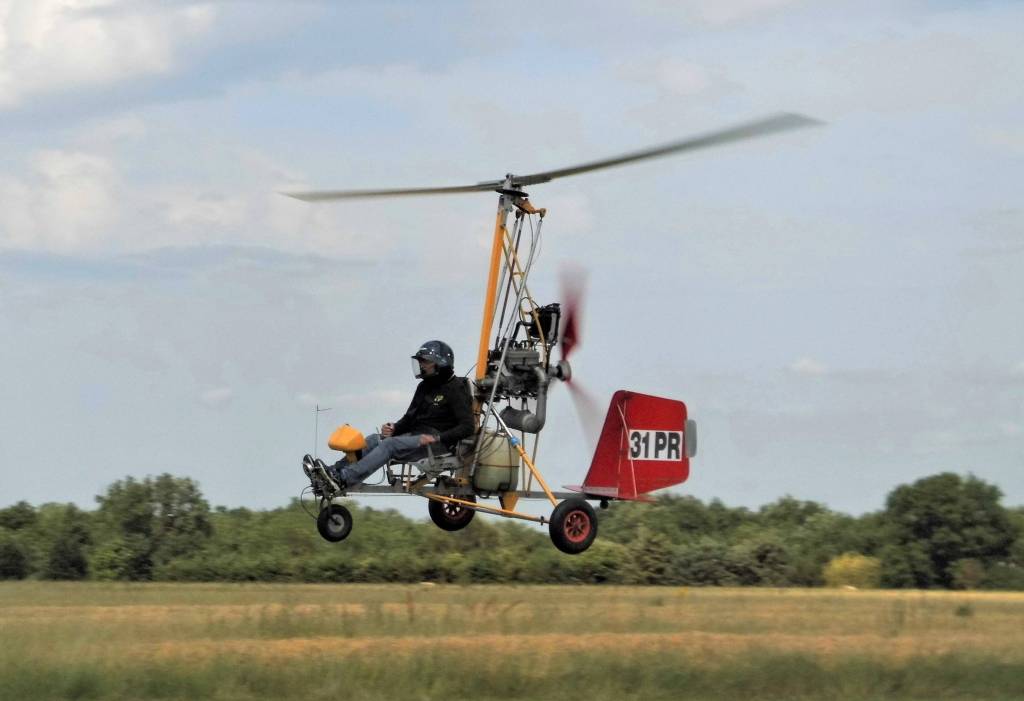
Being small and slow, they had us take off first. As usual there was little wind on this humid afternoon and what little there was of it drifted lazily towards runway 13, which meant an extended hammering for Delta-J, devoid of suspension with six-inch wheels. Taxiing to 31 is bad enough, but 13 is even further away and it takes an age to jolt down to the end. Thoroughly shaken up, we managed to scramble into the air after rattling along half of the runway, trying to get the rotors to show some interest. It was a relief to get aloft and find some lift, slotting into our alloted position as the bigger boys sailed past with nonchalant ease. Later, a repreat performance saw us unstick from Sabo’s rough downhill strip, having requested that Eric proceed us in order to harvest his prop wash and boost my lazy Dragon Wings. It never fails. We trickled back to the Gyro Club in line astern, Pierre formating nicely on our right axle. There aren’t many I would trust to fly that close – but it’s shame my action cam was fastened on the other side!

Pierre de Raigniac. He was a damn fine gyronaut

Safely back on the ground, I got the usual ribbing about flying ‘too high.’ Unable to enjoy the same performance and regular practice as my squadron mates, I don’t share their confidence and prefer to leave myself more of a safety margin. They fly too low for my liking – especially when crossing woods, lakes and rivers! Anyway, back at the club we had barely tethered our rotors before Jean Marie began rounding us up for a flight to his house. I felt obliged to join him. Mechanical gremlins had prevented us from flying together, but now we were both serviceable having finally fixed our respective problems the day before I had to leave. Jean Marie is always keen for us to fly together, but once airborne he doesn’t stick around and ‘together’ usually means a mad tail chase for Delta-J and me. It’s not the way I like to fly.

The warm breath that had earlier failed to encourage my rotor blades was by now non-existent, and Jean Marie decided on runway 31, reducing some abuse on my poor airframe. He was already heading for the threshold as I hopped back in after a rapid refuel, and turned the key. Nothing happened. Hardly surprising that the battery connections had shaken loose again, and a few minutes were all it took to fish out the on-board tool kit and tighten them up. Jean Marie can be rather impatient when he gets the bit between his teeth, and today was no exception. Intending to make good use of his prop wash, I thought he would at least wait for us to line up but he was off and away before I’d even strapped myself in. I had my suspicions this wasn’t going to be easy!

Arriving at the threshold, I pointed Delta-J’s nose down the runway and saw Pierre following us out. However, with our leader buzzing testily overhead I thought it best not to keep him waiting any longer. Bad decision. Everything vibrated horribly as I drove the rotors as hard as I could until they had a nice beat going, but I wasn’t fooled for a moment. It takes barely seconds to release pre-rotator and parking brake, and it took barely seconds for the rotors to visibly lose their momentum. Having done all my training by sight, sound and touch, I’m not a fan of relying on rotor tachs, but in times like these when you’re not entirely sure if the battering is due to rough ground or the rotor blades kicking off, I admit that a rotor tach would be very useful. Lacking such an implement means erring on the cautious side and accelerating probably more slowly than I actually could, rather than triggering blade sail which would really ruin the day.

So we rattled and bumped down to the halfway mark, eyes glued to the rotors for any sign of trouble, and still no nearer to flying speed. They were having quite a discussion between themselves: is it worth the effort of lifting the nose wheel before the last quarter of the runway, or more entertaining to wait until the very end and test the pilot’s reactions? At last I felt some lift beginning to gather and not a moment too soon, so I guess they had about much faith in the pilot as I did. Three-quarters of the runway was now behind us. Ride it out, or abort take off and subject Delta-J to another 10 minutes of horrible ground pounding while we taxi back? Seconds to decide or else we’d be going by road. I knew things would (should!) be better once clear of the sheltering influence of the trees on the other side, so with wheels several feet above the grass, I poured on the power. The response was somewhat underwhelming.

This sluggish excuse for a climb out was not to my liking, neither was our close proximity to the road that crosses the end of the strip. I made a rapid left turn across the neighbouring field and flew parallel to the power cables strung along the road, clawing for every inch of altitude. The anticipated improvement beyond the trees failed to materialise and we were really struggling. Pierre had caught up with us (granny on her bike could’ve caught up with us!), shadowing closely alongside and probably wondering why we were hedge hopping. I was wondering that myself. Engine temperature was rising rapidly but to ease its burden by more than a few hundred revs wasn’t an option, and had we been over anything other than the wide open plain ahead, I would have called it quits and gone back. Jean Marie was a distant speck – so much for taking a last flight together! Hoping for a bit of wind or a patch of lift to cross our path at some point, I settled uneasily into a delicate balancing act, trying to maintain what little height we had without cooking the engine. Pierre’s heavy rotors and huge propeller gave him plenty of lift and he could have easily gone on ahead, but my loyal wingman remained at our side. I miss Pierre.

By this time Jean Marie had completed the bombing run over his village, and I was relieved to spot him steaming back towards us at his usual rate of knots – and even lower than we were. Now we can put an end to this uncomfortable excursion. As soon as he had whizzed by, I checked on Pierre’s proximity and motioned that I was turning for home. We were only 15 minutes away and that was 15 minutes too many as the rotors laboured to produce anything useful from the lifeless air. The poor engine gave all it had, doggedly clinging to the measly 400 feet we had accumulated – ironically I was flying like a Frenchman! Needless to say we staggered home (with a few more grey hairs), and survived another close call. That was not pleasant and I really should know better.

Don’t give in to pressure.

Jean Marie: he doesn’t like heights!

Autorotational musings

Living the dream

From 2008: I wrote this after an idyllic flight one gem of a winter’s day, when Nature was in a benevolent frame of mind – an improbable attempt to capture the elation of autorotation and transfer it to the page. Join Delta-J and me for a wander up the north coast of Cornwall…

It’s a beautiful timeless afternoon at St. Merryn. Pale golden sunshine bathes the familiar scene with a soothing mellow glow, and this old airfield that I love so much seems to be almost smiling. The air is crisp and chill with a freshness like clean laundry, a palpable sense of vitality flowing across the countryside on a lively wind that hints of a buoyant tide aloft. Delta-J sits ready on the tarmac, rotor blades twitching gently as if savouring the breeze in anticipation. She’s all checked out and good to go, so lets do it.

We have a brisk south-westerly blowing about 15-20 mph, a nice steady wind so the rotors can pick up speed by purely natural means. Wind direction dictates that we use the Gyro runway today, slightly downhill, it has the least damaged surface of all four runways (the Long, the Short, and Wendy’s being the other three). To get there we taxi down the Short and across the intersection with Wendy’s, the roughest and most overgrown of them all, so named because it heads directly towards Wendy’s bungalow on the other side of the fence. Jolting slowly over the clumps of vegetation that are doggedly reclaiming the aged tarmac, we reach the relatively smooth threshold of the Gyro runway and stop for a final systems check. Engine temperature normal; test the ignition circuits; zero the altimeter and make a mental note of the time. The rotors are thriving in this excellent wind so after a quick look around for other traffic, we’re all set. Power up to 4000 rpm but we barely crawl forward against the drag of the rotor disc and Delta-J lifts her nose as if to sniff the breeze. Dip the stick forward to reduce the drag and balance briefly on the main wheels as I open the throttle and we leap into the air with minimal ground roll. Almost a vertical take off!

Climb out tracking over the runway just in case of hiccups, but the engine behaves impeccably and we sail across the airfield boundary in fine style. No conflicting traffic, everything doing what it should be doing, so a suggestion of left stick and rudder points us lazily towards the Camel estuary. The wind has lifted us to 1000 feet already, which is as high as we can go until clear of St. Mawgan’s zone. It really is a day to savour; pale blue sky dotted with fair weather cumulus, a pallid sun veiled by wisps of high stratus paints the scene in pastel shades. Even the ocean is peaceful today, an infinite sheet of glistening steel.

There’s nothing like a gyroplane for getting the full panoramic view, so as we have the sky to ourselves – 360 coming up. A desolate moonscape of china clay works dominates the skyline around St. Austell, beyond which the south Cornish coast is silhouetted against the bay. Tracing the coastline down towards the south-west I can just see the dark smudge of the Lizard peninsula merging with the horizon, the most southerly tip of the British mainland. Sometimes the when the air is exceptionally clear, the Isles of Scilly reveal themselves twenty-eight miles off the coast of Lands End, but we’re out of luck today and the very last corner of this green and pleasant land remains shrouded in a misty haze. The distant wind farms of Truro and Carland Cross make excellent landmarks as we pivot our gaze up towards the north coast, we can’t get lost down here.

Tracking along the coast past the popular tourist towns of Perranporth and Newquay, a range of rocky headlands reach out to sea edged in foaming white, they spread like fingers webbed with stretches of golden sand. Follow those pointing fingers and far beyond the western horizon lies America, with nothing but ocean in between, a flight of fantasy for a tiny gyroplane with 30 litres of fuel on board. Instead we continue on the home straight, passing the village of St. Merryn and over the lighthouse perched on the shoulder of Trevose Head, sweeping across the sheltered coves nestling between the cliffs, seven bays for seven days. All that rugged Cornish beauty encompassed in less than a minute, as we swing down the mouth of the estuary to Padstow and complete the circle.

More wind farms lie far ahead at Delabole and Davidstow, a diminutive cluster of matchsticks from here. We’ll go take a closer look after gaining altitude to cross the river Camel, just in case I have to test our gliding proficiency part way across. Gyroplanes have many virtues but unfortunately gliding isn’t one of them! Later in the year the speedboats will be out, cutting swathes through the estuary with helpless tourists dragging behind on unsteady skis. It’s fun to chase them and mimic their patterns in the air above, but all is quiet today and the waters flow undisturbed towards the waiting sea. Safely across the river leaving the deserted beaches of the posh peoples’ playground behind, and cruise on up to the wilds of North Cornwall, happy as a lark as we sail alone through the fresh winter sky.

We’ll swing over to the right a bit and scoot inland as I intend to fly back down the coast later on. Heading vaguely north-east towards the wind farms, the town of Wadebridge straddles the river away to our right and beyond that among the hills lies Bodmin with its homely grass airfield. We’re in their patch now yet it’s strangely quiet for such a flyable day, no other traffic around so perhaps the wind is too strong. Never mind, all the more for us. The ground rises up beneath our wheels to culminate at the high peaks of Rough Tor and Brown Willy, their familiar bulks squat ahead, towering over North Cornwall as we ascend the flank of the county’s rugged spine like a fly on a crocodile’s back. The air is so marvellously buoyant today, the rotors are lapping it up, harvesting free energy that takes us to 2100 feet with only a minimal increase in power.

It’s too nice a day to go tearing around. Drifting cumulus cast shadows over the patchwork of hills and valleys in an ever-changing pattern of hues, and the air grows chilly in their shade. A dark smudge far out in the Bristol Channel hints at the presence of Lundy Island, sometimes clearly seen from St. Merryn, but like the Scillys, it’s hiding today. Beyond Delabole is the bleak wartime airfield of Davidstow, the birthplace of Cornish autorotation back in the early 1960s. It looks quite pleasant at the moment but inclement weather paints a very different scene, lashing the exposed heights with the full force of Atlantic fury. There’s a super wind bowling down off the open moors, tumbling over hills and vales like a mountain stream, it creates a joyful maelstrom of swirling eddies and we bob like a cork in its boisterous tide. Nothing makes me feel so alive!

The slate quarry creeps closer beneath our wheels, distinctive angular ledges cut in to the rock, spiralling down several hundred feet below the surface like a huge grey pudding basin made from Lego bricks. This wind is excellent, a surging flow of vitality that’s perfect for a hover and such an opportunity cannot go to waste. I let it drift us away from the village as not everyone appreciates a noisy gyroplane overhead, so we stop at the edge of the wind farm and turn to face the wind. Airspeed immediately increases to 80 mph, but a glance over the side shows ground speed is barely 20 mph as the wind races down off the open moors. A quick look at the time: the wind has veered, meaning we’ll be more head-on going back which could make the fuel situation interesting if I’m not careful.

First a clearing turn to ensure that no one will sneak up on us while we’re hanging around, and I’m amazed that we still have the sky to ourselves. Why is no one else enjoying this glorious day? All clear, ease back on the stick and watch the airspeed drop as her nose comes up, leaving the engine at 5000 rpm and see how slowly we can go without losing height. It feels like we’re sitting on our tail – lovely playful wind! Airspeed registers 20 mph and still it supports us in a delicious hover, united in harmony with the giant wind turbines busily threshing the air below. What a set of rotor blades they would make. Floating above in my own tiny turbine, holding our equilibrium with just a twitch of controls, I can only describe it like riding on a dandelion seed as I let the wind drift us back towards the coast. I am so lucky to do this.

Much as I’d love to stay and play, fuel burn regretfully dictates that it’s time to leave, so we level out and power up to push through the wind, airspeed rises to 75 mph but the ground passes beneath us at a crawl. Crossing the mythical lands of Arthurian legend, we rejoin the coast at the ancient ruins of Tintagel castle and settle down to fly back along the cliff tops. I like to trace the nooks and crannies of the coastline with our wheels, another jolly game invented by Tony Philpotts. He taught me to line up a main wheel with the cliff edge and snake in and out of the coves and inlets as we ride along, bouncing in the turbulence off the sheer rock below. Slow progress but super fun! A warm glow permeates the western sky like sunlight through a stained glass window. Scattered clouds blush with a hint of pink and copper, and the sea blanches to a pale turquoise of almost luminous quality, flecked with gold and edged with a frothy white lace of foam.

Skirting the harbour village of Port Isaac, the gaping mouth of the estuary lies ahead and it’s time to square up and fly tidy again, as we approach the zone boundary. There’s so much lift in the air that Delta-J doesn’t want to come down and we’re throttled back to 4000 revs before she slips into a modest descent. We cut inland from Pentire Point and level out to cross the river, passing sleepy Padstow snuggled behind the protective arm of the harbour wall. A quick vertical descent drops another 500 feet so as not to worry St. Mawgan, just in case they have the binoculars out in the tower (we’re too small for their radar to identify alone). A familiar pattern of silent runways lie ahead as St. Merryn comes in to view, and I rouse myself to wake up and get with it after such a long and lazy ride.

It’s hard to spot the faded windsock against the gathering dusk, but yes, the wind has veered to the west which means landing on the rough and tumble of the Short runway. We swing round to line up on the heading, keeping the power on just a bit longer as the wind is still quite feisty and I want some height in my pocket should the engine quit. Cross the old perimeter road and in over the parachute club’s portion of the airfield: they’re not active today, grounded by the same glorious wind that has been such a gift for a gyroplane. And now we’re home. 350 feet at the boundary fence with 50 mph on the clock, we drop swiftly, the wind having a last mischievous tug at us as we slip from its clutches back to earth. Gently check back on the stick and hold her there as the speed falls away to settle nicely on the main wheels, the rotors take the load with a jubilant whop! and stop us in our tracks. I wait a few seconds to lose some rotor speed before taxiing back to the hangar, tired, cold and stiff and utterly content. What a fantastic afternoon – happiness is an empty sky and a little red gyroplane!

Autorotational musings

And that was that

So farewell 2019, and most enjoyable it was too. Highlights being the successful culmination of the Brookland Rotorcraft project: a rare Mosquito gyroplane preserved for posterity, and the place of Ernie Brooks now officially cemented in British autorotational history. Well done, Trevor and Peter! How do we top that…

It goes without saying, two wonderful trips to Bois de la Pierre to reunite with my Delta-J and make sure the Pyrenees are still there. Helping out with another safe and successful annual Gyro Club rassemblement is an essential part of every year. We had all kinds of weather: dramatic thunderstorms, torrential rain and howling winds to searing heat and skies of clearest blue. Delicious flights over a panoramic landscape with the song of the rotor blades in my ears, made even more special when shared with friends. How did I get to be so lucky?

August saw the 20th anniversary of Thenac aerodrome, near Bergerac. It was a pleasure to be part of the celebrations, despite the relentless heat that flattened the two visiting Brits! A fun weekend of feasting and ultralight flying in great company. Congratulations to Marie and Martial, ably abetted by the Patrouille de Thenac.

It was during that weekend that I was treated to the wildest ride I’ve yet experienced in a gyroplane. Actually, I’m not sure it’s possible to get any wilder and still use the aircraft again afterwards. Ye gods, I enjoyed it thoroughly – afterwards – when my brain had caught up with the rest of me! Wow. Having flown with Patrick at Sainte Foy in 2012, I had an idea of what to expect, but that was a gentle stroll in comparison. He has an aversion to flying straight and level in his immaculate M16, and routinely pushes normal flight parameters.

Snug in the rear of the high-sided pod, clad only in T-shirt and shorts, headset and sunglasses (no crash helmet), I fastened the lap strap as tightly as it would go. It’s a big regret that I didn’t have time to grab my video camera, what a film that would’ve been. All that remains of that epic flight are the snap-shot images in my head, such as peering straight down at the ground barely a rotor’s length away, with the disc bisecting the horizon at ninety degrees! But what a ride.

The temperature was a stifling 32 degrees C, with barely a breath of air to ruffle the windsock: my little Cricket would have struggled horribly in such conditions. A powerful beast is that M16, and Patrick didn’t waste any time. Barely attaining 300 feet on climb out, he stood it on its tail and pivoted the big machine through a 180, powering back in a low pass along the runway to swing up over the field of sunflowers at the end. We went up, we went down, fast and fluid, our wheels seemingly inches above the dry earth as we blasted between the trees at impossible angles, accompanied by the heavy beat of hard-working rotor blades. No roller coaster could ever produce such a thrill. Supremely confident and smooth on the controls, Patrick was in his element as he handled the big Magni like a jet fighter, twisting round in his seat to give me a beaming thumps-up, which I was delighted to return.

Back over the sunflowers again, we roared down the runway at a matter of inches, using the momentum to swing up and stand the machine on its tail for the obligatory hammer head. Poised in mid air, nose to the sky, the airframe spun like a compass needle beneath the span of rotor disc to point back from whence we came, floating in for a gentle touch down as the rotors expended their energy in triumphant song. Hell yeah – that was absolutely awesome!

Autorotational musings

G-YROX goes global

Norman Surplus is a very brave man. Having overcome a life-theatening battle with bowel cancer, he went out and learned to fly a gyroplane, shortly after which, in 2010 he promptly set out to fly it around the world. After many setbacks that would have thwarted a lesser individual, Norman and G-YROX returned safely to the playing field in Larne, Northern Ireland, from where they had taken off on their epic adventure, five years earlier.

Photo, Larne RFC

I will never forget being glued to the little dot that represented Norman’s GPS tracker, watching it cross from the American continent to Greenland, all the way down the coast of that inhospitable terrain and over the dangerous waters of the North Atlantic, willing it on to the relative safety of Iceland. I was at my desk (supposedly at work) flicking rapidly between the multiple databases of military logistics and Norman’s website, unable to tear myself away from the magnetic pull of his progress. Then the long awaited final stretch, down from Iceland to Scotland and back across to Larne, triumphant!

All alone around the world. A microscopic dot above the heartless expanse of oceans, mountains and tundra, wholly dependant on a single engine in an open cockpit machine with the gliding ability of a house brick. To say that Norman Surplus is a very brave man, doesn’t do him justice.

It was hell of a trip that he made, setting several world records in the process, but due to political and bureaucratic complications, pieces of the puzzle were missing. There were unavoidable gaps in his achievement. But not anymore. Accompanied by another gyroplane pilot who is trying to emulate their success, Norman and G-YROX have crossed the vast expanse of Russia and this week they have reached the Pacific coast. Fantastic effort! And they’re not done yet.

Norman is raising money and awareness for his cancer charity. Please support him and give a donation to the cause.

http://g-yroxtimeline.yolasite.com

https://www.facebook.com/GyroxGoesGlobal-143540602375581

Autorotational musings

Salute to the past.

I wrote this in 2015, after an idyllic afternoon with my gyroplane on a special day. It was only meant as a private musing but it’s from the heart, so I’ll put it here in tribute to those who have been part of our autorotational journey.

G-BVDJ is 21 years old today. It was exactly 21 years ago on a Sunday afternoon at St. Merryn, when Chris Julian took her into the air for the very first time. The pile of metal we had carefully cut, shaped and bolted together now transformed, the process of creation hadn’t been in vain. I still remember how elated I was, how pretty she looked in the sky – how impossibly tiny. There were teething troubles naturally, little niggles to be ironed out over the following months, but now I owned a real flying machine. How cool was that!

Never in my wildest dreams did I imagine that 21 years later (29th May 2015 to be exact) we would be in the south of France, stirring the air together under the imperious gaze of the Pyrenees. Back then I had rarely left British shores and certainly had never ventured abroad by myself. To actually drive alone, some 800 miles on the wrong side of the road in a language I can barely speak, not to mention towing the most important part of my life behind on a trailer – nah, don’t be daft! Yet here we are, and it’s all because of gyroplanes.

21 years. That little red machine changed my life completely. With the encouragement of the late, great Ken Wallis, I left my home and moved 200 miles to be near our beloved airfield at St. Merryn, where a small group of veteran gyronauts patiently kept me the right way up as they shared their wisdom with the neophyte. ‘She won’t fly’ said the critics, ‘girls don‘t fly gyros.’ ‘She flies’ said my mentors, ‘like a bit of silk.’ And thanks to them and the gyro-glider, I did. They’re all gone now, the gurus whose autorotational roots traced back to the 1960’s, but the memories we made together and the skill they gave me to survive lives on, encapsulated in Delta-J. The little red machine they helped me to create and to master exists because of Chris Julian and Tony Philpotts. Along with Bob Partridge and Les Cload, their knowledge and friendship remains a vital part of the fabric that made me a gyronaut. They fly with us always.

As does the man who has done (and continues to do) more for the ordinary British gyronaut than any other – the unassuming and unsung hero that is Tony Melody. He took this gyro-glider fledgling who some said would never fly, and defied expectations by moulding a bundle of nerves into a qualified gyro pilot. A female one at that. Whatever next! And not forgetting Mark Hayward, who with his yellow Bensen lead us on many adventures, helping to build this new gyronaut’s confidence in straying from the local patch. Tony and Mark, to share your experience and great sense of fun has been an honour and a pleasure. You too will always be part of us.

That little red machine changed my life. Cursed with shyness, it’s almost impossible for me to make friends. People don’t notice you when you’re shy, normally I’m invisible. Delta-J defines me: with her, I become someone. People see who I really am and want to talk – ‘What is it? How does it work? Do you fly it?’ Since I took my first step on the autorotational path in 1990, all the friends I have are the direct result of becoming a gyronaut. People all over the world – many of whom I have never met – but brought together by the love of my little red flying machine. There are people who have travelled many miles to trust me with their lives, learning vital skills while enchanted with the magic of the gyro-glider; even now they keep in touch. I’m truly privileged.

The pioneering spirit that infused St. Merryn no longer survives in Britain these days. Any sign of enthusiasm for the homebuilt gyro is immediately crushed by the ignorant, and with it dies the innovation and curiosity to evolve. My veterans would be saddened by what we’ve become. Individuality is frowned upon and commercial clones have no soul. Even the basic skills are gone, the essential now re-labelled ‘old fashioned’ by those with no clue. But cross the English Channel and a whole new world of possibility opens up, and it’s here that Delta-J and me have rediscovered what we thought irretrievably lost.

21 years of memories, the strong roots that hold us firm as we begin our new incarnation with the friends who have become as important to me now as those of old. On this beautiful grass airstrip of Bois de la Pierre, the Gyro Club Toulouse has embraced our lost soul and given us new purpose. A positive attitude does wonders, innovation and ingenuity are alive and flourishing. The spirit of adventure and shared passion for gyro flight binds us in a strong community that’s joyful to be part of. The few commercially built machines co-exist in harmony with the homebuilts, just as it should be. If only the Brits could be so open minded.

So it’s nicely fitting that Delta-J should commemorate her 21st birthday with a flight from Bois de la Pierre today. A very different landscape from that where we began: huge open countryside with no sparkle of ocean on the horizon, just a colossal barrier of snow capped mountains to the south. It was an emotive flight through an overcast sky as we celebrated her coming of age and remembered all those who had made it possible. She’s more than just a machine, you see, every part of her holds a memory.

Sometimes I just can’t believe how lucky I am – and it all stems from Delta-J. I can’t imagine where life would’ve led me if I hadn’t discovered gyroplanes, but I’m sure it wouldn’t be a patch on this!