Flying as an ‘Ulmiste’ in the south of France is very different to being a gyronaut in the UK. Gyroplanes are a class apart under British regulations: a very special class, which automatically excludes them from any concession granted to other flavours of homebuilt aircraft – and always for a very good reason that no one can actually explain. They don’t understand us so they trap us in a time warp, unable to evolve and barely tolerated. Such a huge contrast in attitudes.
French gyroplanes fall into the microlight (ULM) category – even the big factory-built machines qualify. What a world of opportunity this presents! The freedom to investigate and explore: to try out ideas and improvements, to nip down the local hardware store and gather all you need without certificates, batch numbers etc, and the inflated aviation prices that come with them. It took a long time to get used this new approach after 20 years of negativity and heavy over-engineered 1960s gyroplane designs – I just couldn’t believe it was all so simple – surely there was a catch? But it never came.
When I took my Cricket down there in 2009, it was the first time they had seen a British designed single-seater, and without fail she drew the same three reactions in exactly the same order. First impression, the exclamation invariably ‘How small and cute she is!’ (like her pilot. Ahem). The French machines are as half as big again, with tall masts to accommodate large propellers. A second glance, the glaring deficiency is all too obvious: ‘Why do you not have a stabiliser?’ Basically because our authorities are still in the dark ages where gyroplanes are concerned. I’ve yet to see a French autogire without one, and our distinct lack of tail feathers caused great consternation among our new friends, a fire which continued to burn unabated until I was later able to join them in the 21st century.
The third reaction without fail was total conviction that the British are quite insane. And who could argue? Fastened inside the pod of my machine – my tiny single-seat open cockpit flying machine as per British regulations – is a ‘No smoking’ sign. The hilarity was absolutely justified. They do not allow a horizontal stabiliser, yet you MUST have a No smoking sign??!! I couldn’t explain it either. (10 Years on, British gyronauts have now been permitted to bolt a cumbersome and inelegant flat plate to the tails of their Crickets. The ‘No smoking’ bit still applies.)
Flying down there is very different. I don’t pretend to know all the ins-and-outs, my understanding of the French language remains at a very basic level despite all efforts to improve. My friends credit me with far more intelligence than I actually possess, and regardless of attempts to understand pertinent ULM web sites, I still rely heavily on them to keep me on the straight and narrow. I’ve always hated radio and have struggled to cope with it ever since fixed-wing training. While the jargon poses no problem, the mental block to get the words out and broadcast to one and all across the frequency is an almost insurmountable challenge – a hang-up deeply rooted in my general inadequacy with verbal communication. I’m sure I was a mouse in a previous life (still got the teeth), preferring to remain hidden and not draw attention to myself, anony-mouse as it were, but it’s very frustrating at times.
During the week, the aerial prerogative over the plain belongs to the Armée de l’Air. I’m not too comfortable flying on a weekday! It’s not uncommon to be happily minding our own business at the club, only for the peace to be shattered by an unearthly roar and dark shapes ripping through the circuit, sometimes a fleeting glimpse of fiery jet pipe barely 200 feet above. And they’re always in pairs. The Patrouille de France take no prisoners either. Nine Alpha Jets blasting through the area at minimal height, at least two of them directly through our circuit. A hapless gyronaut would be chewed up and spat out before they even knew what hit them. Even their wake turbulence would be enough to ruin your day.
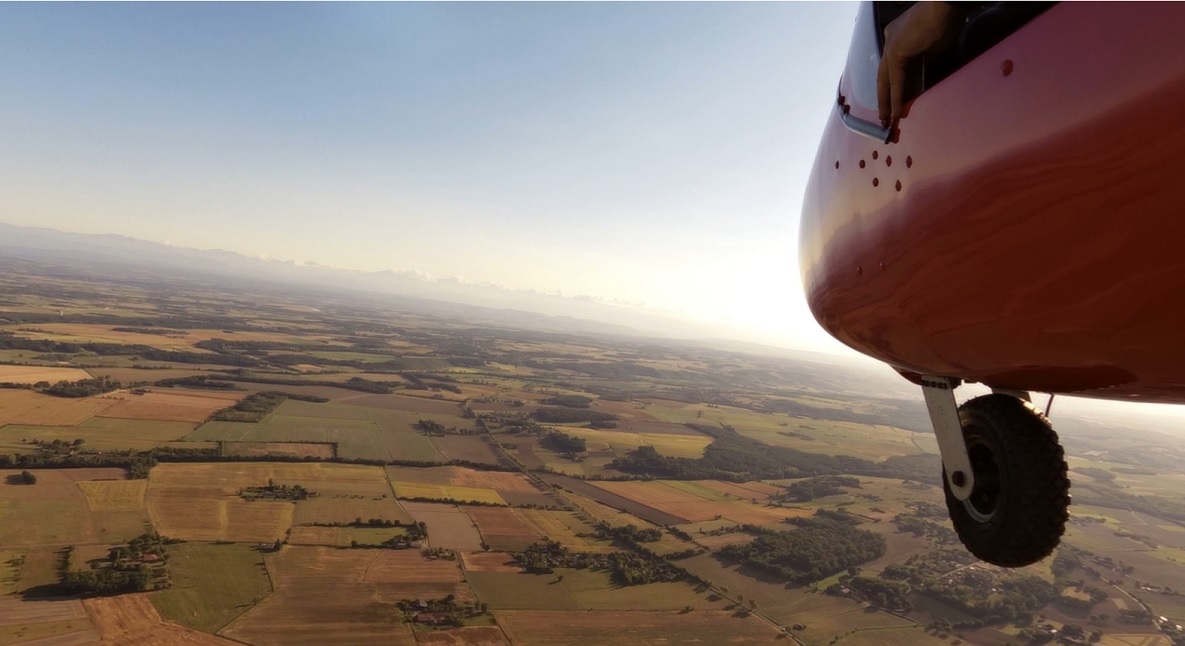
Don’t go too high, my friends warn after persuading me to partake of the week-day sky. They habitually fly around at 400-500 feet, which seems like hedge skimming as I look down from the relative safety of 800 feet. My flying opportunities are very limited being based some 700 road miles from my aircraft (depending how many detours the satnav finds), so confidence levels diminish accordingly with lack of hours. I prefer a decent bit of altitude beneath us, a few extra seconds of safety margin to compensate for my lack of practice should anything untoward occur.
Although we wear the same Rotax 582 engine as several other single-seat machines at the club, they sport unique configurations able to accommodate much larger propellers and rotor blades. My gyro being based on a heavy 50 year-old design, only has room to wear a petite 52 inch propeller, which coupled with our lightweight 22 foot diameter rotors cannot hope to match the performance of our French companions. Only a complete restructure would solve it. Consequently they don’t understand my reluctance to fly in the high temperature and light wind conditions that persist from late May onwards – we just don’t have the same oomph! On squadron fly-outs, the others casually breeze past and disappear into the distance leaving us to flounder in their wake, my poor engine screaming in protest, temperature gauge nudging the red as we struggle for a morsel of lift in the tropical haze. So yes, I’m wary – it’s not a good feeling when your rotor blades have nothing to bite.
 Spinning on the Wind